A team of specialist agents,
built around your work.
Start with ready-made Geniuses or create your own. Give each one a job, the tools and data it can use, a schedule or trigger, and rules for when it must involve a person. They work independently, share what they learn, and leave a record of everything they do.
What makes a Genius
A Genius is not a prompt. It is a worker that accumulates.
- 01
A charter, not a prompt
A written job description: what this Genius owns, what it does not, and what finished work looks like. It is measured against the charter, not against however you phrased things this morning.
- 02
Memory built to be evidence
A storage layer of our own, built for record-keeping rather than conversation. It holds what was true and what we knew when we acted, so a question about a decision six months ago is a query rather than a reconstruction. It also holds how things depend on each other, so when one input moves you can see what else it touches: which valuations change, which positions are exposed, which findings no longer hold. That is why a Genius in month six is worth more than the same one in week one.
- 03
It builds, not just answers
A Genius composes new things out of what already exists: a spread, a basket, a synthetic curve, a derived metric assembled from other metrics. The new object is a first-class part of the system, so it can be priced, tested, monitored, and reasoned about like anything else. Nothing here is specific to trading. Anything the platform can represent, a Genius can combine into something new and then test whether it holds up.
- 04
Approved tools and data
The exact feeds, systems, and databases it may touch, granted by your team and enforced by the database rather than by instructions. A Genius cannot talk its way past a permission, because the permission does not live in its head.
- 05
It works without being asked
On a cadence you set, or on an event: an email lands, a price moves, a filing posts, an overnight job fails. It brings you the finding rather than waiting for you to think of the question.
- 06
Swim lanes
Language models are probabilistic. The decisions built on top of them do not have to be. Every Genius runs inside fixed lanes: criteria written down before the work starts, what it may do alone, what waits for a person, and when it must escalate. The same evidence produces the same verdict every time, whoever is watching and whatever mood the model is in.
Ready-made to start, yours to extend
Run one as it comes, tailor it to how your desk works, or define a new one around a job nobody has time for.
A second opinion on what your ETRM tells you. Describe a power or gas deal and it structures the transaction, prices it, explains what it is exposed to, and compares the result against your production system. Feed it live market data and see how the positions respond. Covers virtuals and transmission, battery, tolling, PPAs, and gas storage and transport.
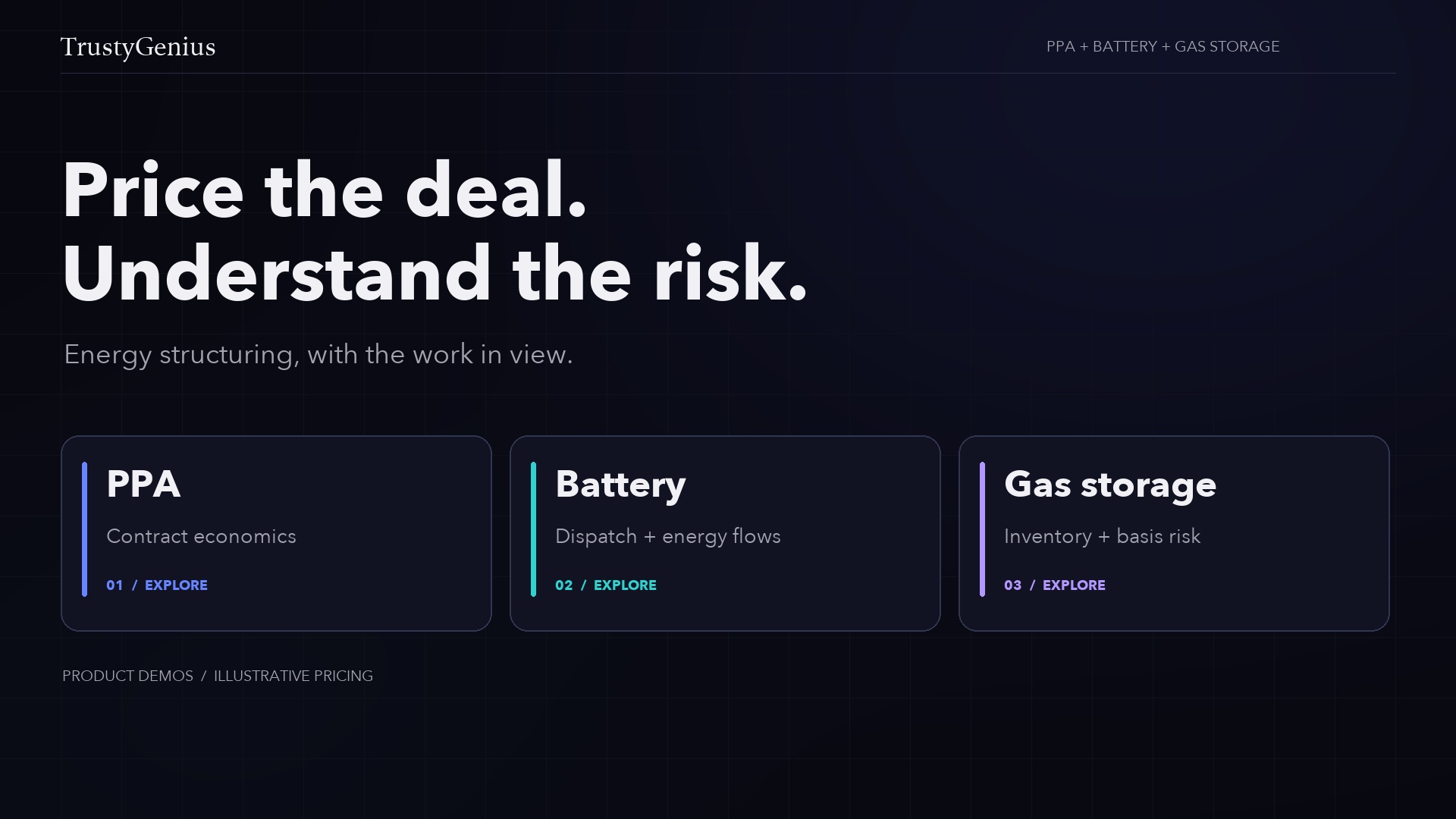
84 seconds · PPA, battery and gas storage
Brings you structures that already survived scrutiny. It reads the chains and the surface, proposes a trade, and puts it through exit-plan, critic, and risk review before it reaches the paper book. Most ideas do not make it. Supports futures options with the required contract definitions and your licensed option data.
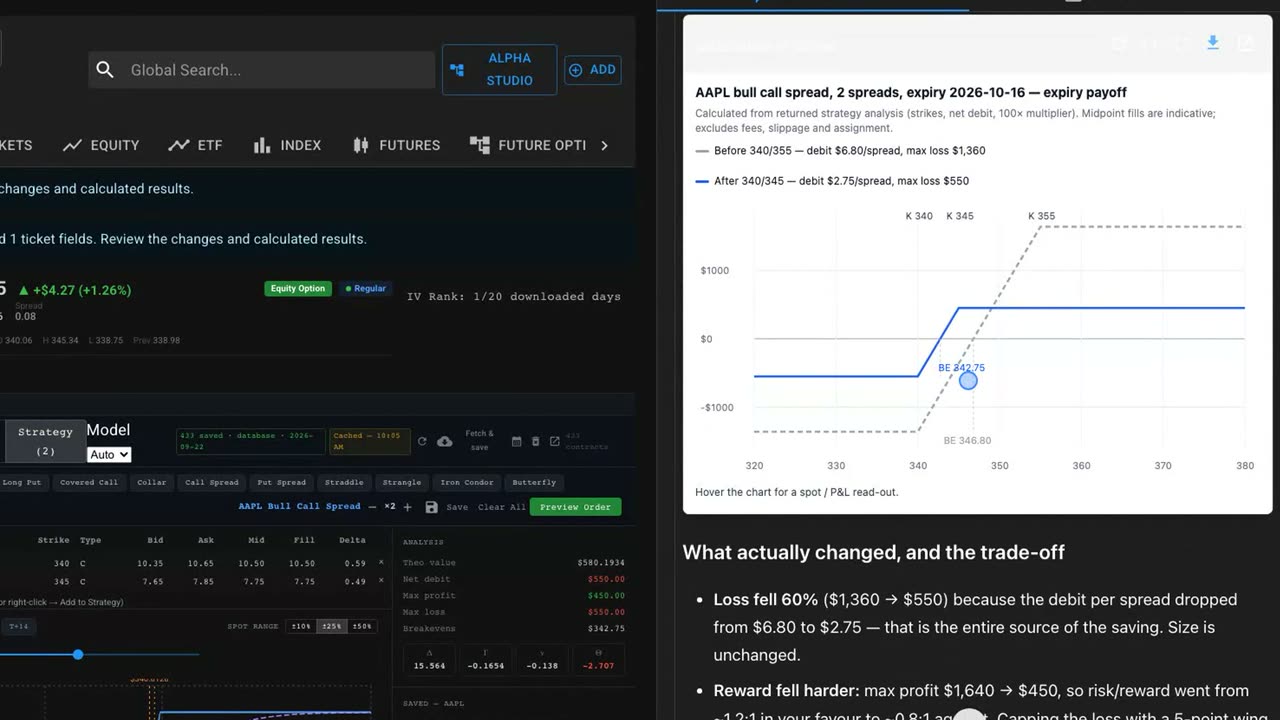
Equity example · Futures options with configured customer data
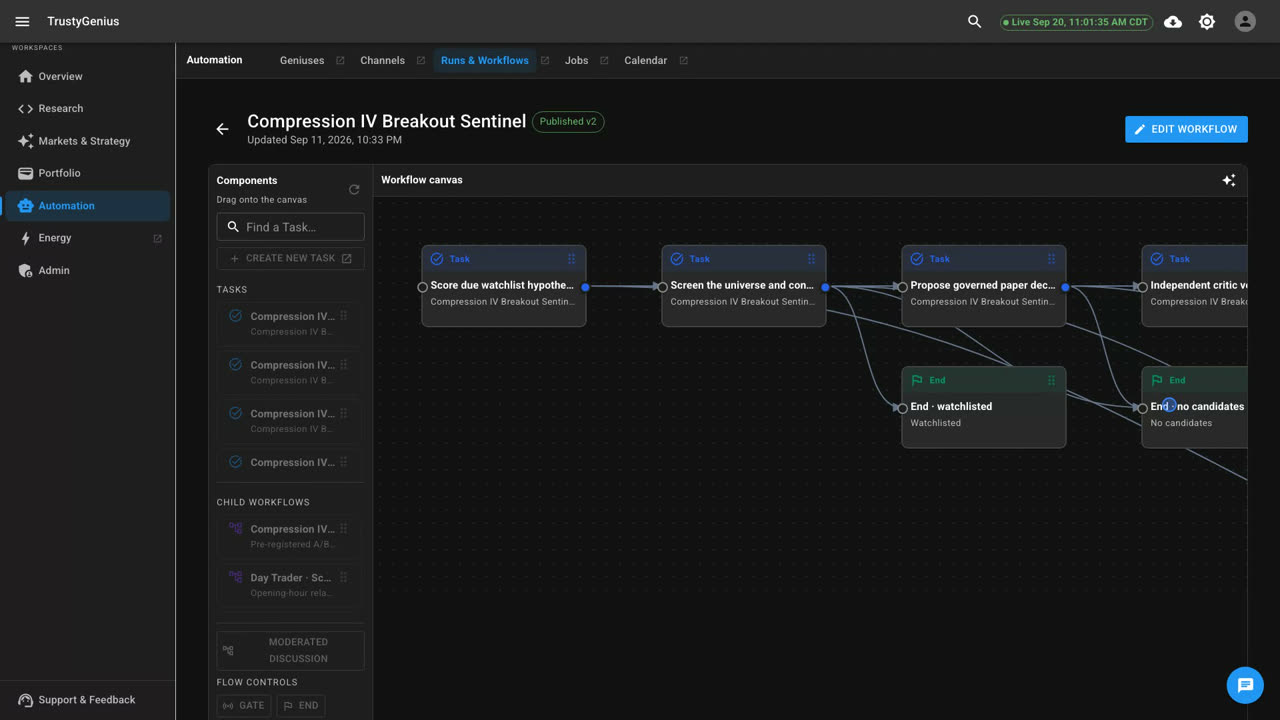
Runs work that takes several Geniuses and several steps, on schedule, stopping at the approvals you set. You see the finished chain of reasoning, not eight separate conversations.
Watches the paper book so you do not have to. Sizes positions, tracks rolling Sharpe, Sortino, and drawdown, enforces limits, and flags an edge that stops working before you notice it has.
A briefing on your desk before you sit down. Watches a universe, reads filings and price action, and logs what it learns so next month's briefing is sharper than this month's.
Catches bad data before it reaches a trade. Checks feeds against vendor instrument masters, flags stale prices, missing points, and duplicate instruments, and raises the finding with evidence.
Works a role inbox end to end: pulls the details out, updates the systems that need updating, schedules the follow-up, and escalates what it should not decide alone.
Watches job runs, failures, and deploy health, and escalates what needs a person. The platform holding itself to the same standard.
Define the job, the data and tools it can touch, when it runs, and what needs your sign-off. If your desk has a job worth doing well, you can staff it.
Your quants work in the same environment
The agents are not a black box. Everything they can do, your quants can do by hand in the same sandbox: pull data, build and test ideas, run scenarios, and work a paper book. The platform extends around how your desk already works.
- ▸Same tools, interactively. Your quants work with the same capabilities the agents use, by hand when they want to.
- ▸Bring your own. Plug in your data feeds, brokers, and internal systems, and the agents can use them too.
- ▸Sandboxed. Scripts and tools run in a contained environment, with the same permissions the agents have.
Nothing reaches the book on a good story
Every strategy is held to a standard set before it runs. It has to prove itself before it touches the paper book, and keep proving it while it runs. The path is the same every time: research, validate, paper trade, monitor, review. It stays in research and simulated paper trading throughout; TrustyGenius never places a live order.
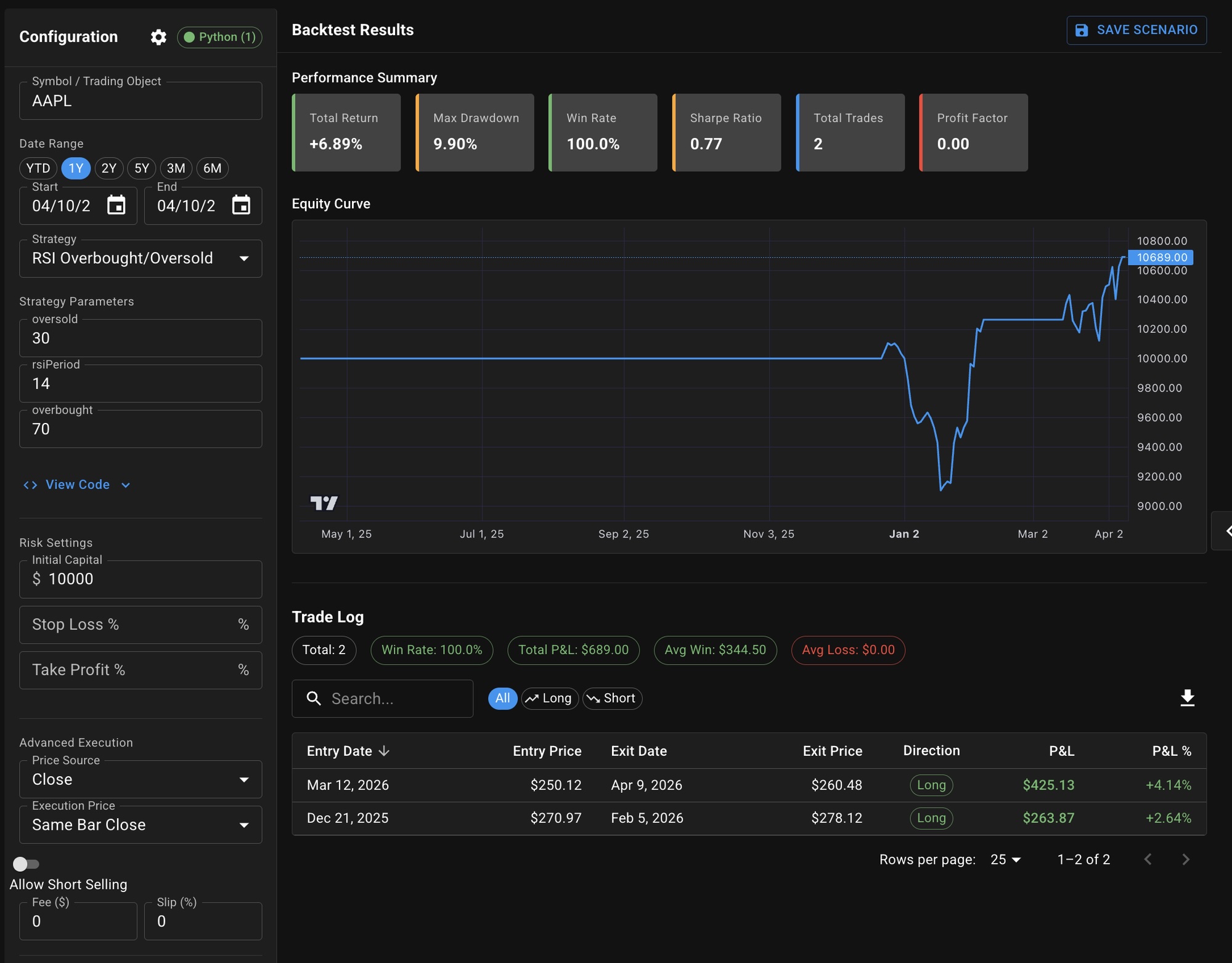
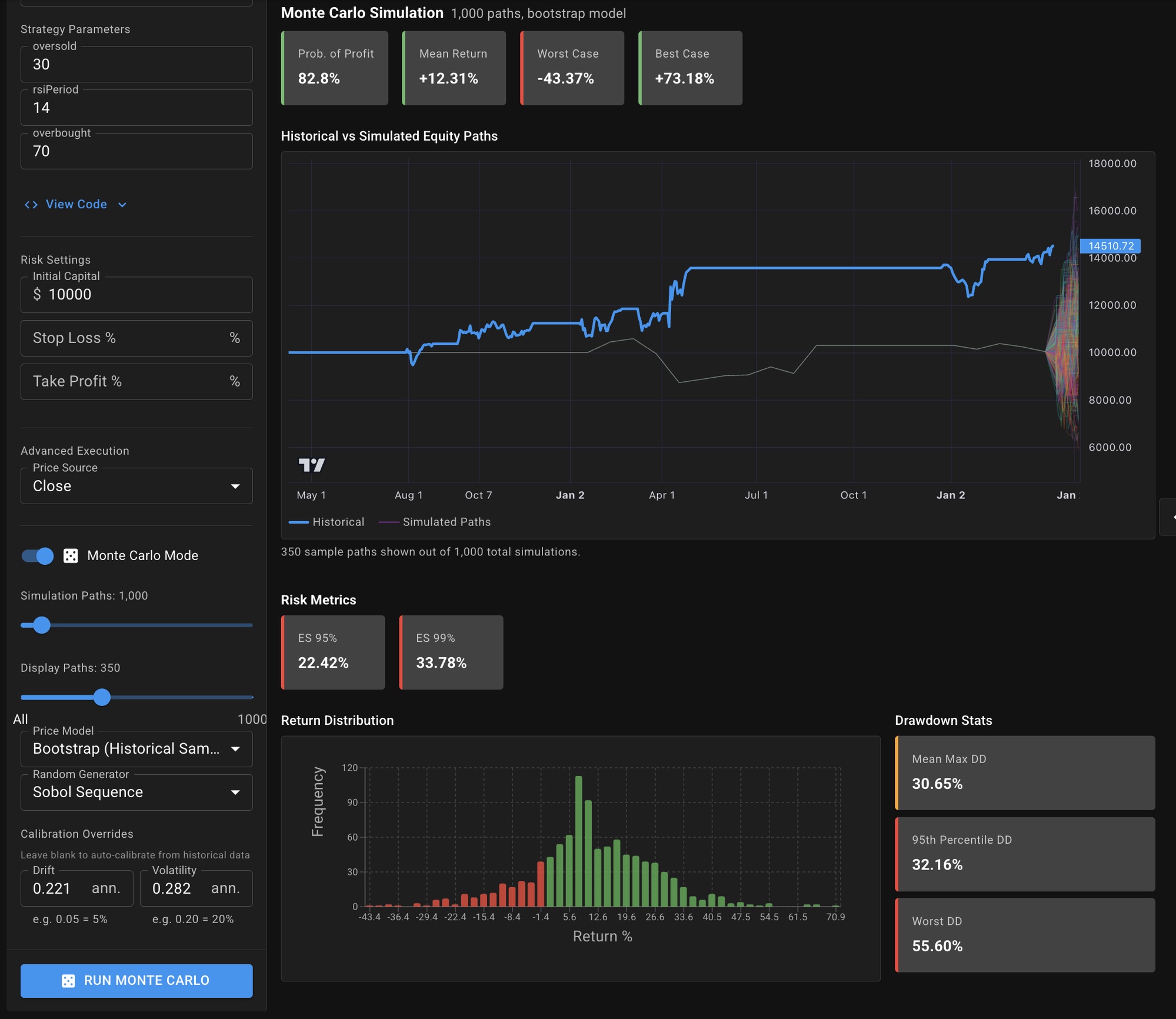
Inside the research workspace
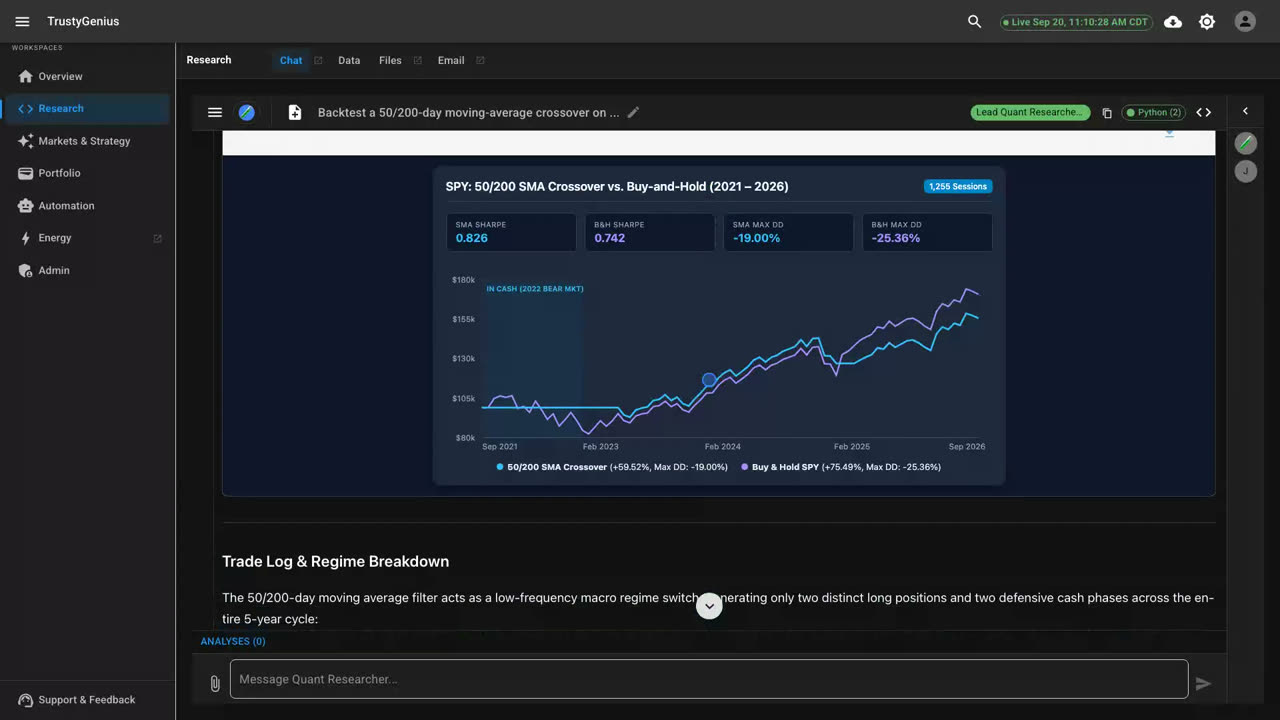
Backtesting and Monte Carlo analysis in the actual app. Results shown are simulated research examples.
Sources and integrations
Out of the box. Custom feeds slot in via a Production Agent Sprint.